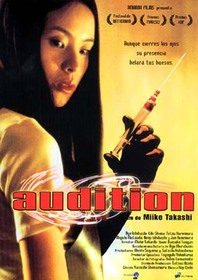
Audition is a devious film, the
kind that draws you in with well-developed characters and a
patiently-paced plot but that eventually begins hitting you
unapologetically with scenes of horror before finally bludgeoning you
at its climax. Made by Takashi Miike, a master of inserting obscene
levels of violence into well-measured stories, this is a film that
builds up to an explosive finale that is virtually impossible to be
perfectly unspoiled (assuming the viewer looks at the DVD packaging
or poster art before watching the film) but nevertheless hits with
such unexpected force that it can leave you sick. Aside from simply
setting you up for a punch in the gut, however, Audition also
quietly illustrates the extent of our acceptance of male dominance in
society.
Shigehiko Aoyama, a film production
company executive, lost his wife seven years ago. Left to take care
of his teenage son Shigehiko and dog Gang, Aoyama is nothing but a
nice, caring father and all-around good guy. Now he feels the urge to
find a new life companion. When he expresses to friend and film
producer Yasuhisa Yoshikawa the wish that he could examine women's
lives and immediately pick the best one out to be his wife, Yoshikawa
comes up with an idea: hold a fake film audition and find a potential
romantic partner by interviewing applicants. After falling in love
with applicant Asami Yamazaki practically before even meeting her,
Aoyama begins dating the woman. However, as he falls more deeply in
love with her, Asami's past and personality become more and more
unclear, and eventually Aoyama will find himself in one of the most
horrific scenarios imaginable.
Roughly the first two-thirds of
Audition are presented in as a standard drama, focusing first
on Aoyama's newly budding desire to once again have a wife and then
on his search for love and his courtship of Asami. Miike directs this
portion of the film fully to present Aoyama as a morally good
character. He smiles softly when interacting with others, he is
actively interested in his son's happiness, and he is perfectly
gentle toward Asami. Furthermore, we are made not only to like Aoyama
but to sympathize with him, as a man who lost his wife (to what
precise ailment we do not know), who is shown brooding for most of
the first few minutes of film, and who now feels an emptiness in his
life. It would be hard to imagine a more likable character.
However, in its emphasis on Aoyama as a
morally good character, Audition (purposely) overlooks the
dishonesty and selfishness inherent in his plan to find a wife. While
Aoyama initially has some misgivings about the fake audition, he and
the viewer quickly accept it as a generally harmless means of
achieving an end. However, late in the film, Asami chides Aoyama for
the ruse. While Asami's explicit claim is that all male casting
personnel attempt to leverage the hopefulness of female applicants
for their own sexual pleasure, we can also tie her anger into a
recurring theme of her own submissiveness to the world around her.
Asami, a former ballerina who suffered a career-ending hip injury,
likens her acceptance of the injury to an acceptance of death,
something she accepts emotionally because, as she states, that's
simply the way life works. Additionally, just as Asami is submissive
to her medical and physical situation, she is also submissive
socially, even to the point that Yoshikawa points out her obedient
nature as a favorable attribute insofar as it relates to her being a
potential love interest for Aoyama. These elements of dominance and
submission play out in such a natural manner that indeed it is
difficult for the viewer to view Aoyama as particularly dominant in
any way, even when we learn of Asami's hurt.
 Asami at home
The traumatizing ending to the film
upsets our hopes for Aoyama, just as Asami's hopes have been upset.
However, we are not aware of that when watching the events play out.
Instead, we feel only sympathy for Aoyama and anger toward Asami.
That is Audition's great deceit, and it confirms the film's
core concerns. Despite her having lived a difficult and submissive
life, we cannot empathize with Asami, and her breaking through her
submissiveness becomes an abject act, not a commendable one.
Likewise, even though Aoyama lives what must be viewed as a
privileged life, and even though he used deception to find a
potential wife, we fully understand and sympathize with him
throughout the film. Indeed, the blunt and painful ending to the
movie is not only an attack on Aoyama but on the viewer as well, a
retaliation for our own happy acceptance of the dominance to which
Asami has submitted.
On a casual viewing, it's difficult
to glean a point from Audition. It's the story of a man
finding someone to be his wife and eventually going through a handful
of wild experiences before his love interest turns on him. We get a
few shocks during the build-up and one major shock at the end. Even
to those actively picking the film apart as they watch it, there can
appear to be little point to it beyond its shock value. That is its
trick, and that is why it punishes us with an ending so difficult to
watch. We're so given to the acceptance of the characters' social
roles in the film that we don't even see the retaliatory
underpinnings of Asami's actions.