One can’t help but to smile fondly when one hears the line, “They’re all going to laugh at you.” Carrie was the first, and undoubtedly the best of Stephen King’s book adaptations. What gives Carrie its staying power? The fact that underneath the supernatural overtones, this film remains to be one of the most realistic and relatable cinematic tragedies of modern day.
For those who have been living under a rock, Carrie is the ultimate tale of the cruelty of high school. Carrie White is an outcast in school (mostly due to her obscenely religious mother), and gets tortured by all the popular girls in school. The thing they don’t realize is Carrie becomes telekinetic when she gets angry (she can move objects with her mind), an anger which continues to grow until it peaks to an uncontrollable and frightening level after a poor-taste prank was pulled on her at the high school prom.
There are many reasons why this film is such a landmark of cinematic horror. First of all, it is Stephen King’s first book-to-film adaptation, and is one of the very few adaptations that was done well. This isn’t really saying much. To give King credit, his books are almost impossible to adequately adapt into a two-hour film because they are so convoluted, and editing out any plot point takes away so much from the overall story. As he is one of the few authors who has absolutely no issues with continuity or leaving all his ends tied up in the end, when his books are edited to make a film, plot holes ultimately result. This isn’t the case with Carrie because it is an unusually straightforward, relatively uncomplicated story for him, and therefore is the perfect book to adapt to film.
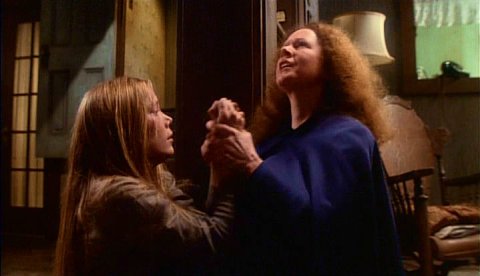
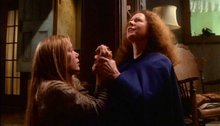 Sissy Spacek and Piper Laurie in Carrie (1976)
Secondly, it is the film that showcased Sissy Spacek’s range of acting talent. From a purely physical standpoint, getting someone who fits the bill of Carrie is a difficult task. She has to look like any other “forgettable” girl from high school, be unconventionally pretty but completely capable of hiding her beauty, and appear meek but also be completely convincing of rage. Oh, and she has to have acting skills too. Finding a young person who can be vulnerable and menacing is an extremely difficult task, but Sissy Spacek played the part perfectly. The scenes I found the most impressive are the first scene and the last scenes. In addition to drawing a perfect character arc (humble and vulnerable to powerful and menacing), these scenes showed the range of her talents. Carrie instantly became a tragic and likeable figure in the opening shower scene when she unexpectedly receives her passage into womanhood to which the girls respond by cornering her in the shower and throwing feminine products at her. Watching that for the first time, you can’t help but to squirm because either you were a student like Carrie who was ridiculed like this at one point or you felt a twinge of guilt for tormenting someone like her in school.
During the final scene, when Carrie goes haywire at the prom, her actions leave the audience with mixed feelings. The first is fear from the pure rage that she emits. The second is sadness, because Carrie is a likeable and relatable character, and -- even though you know where the story is going -- you were still holding out a little hope that everything would work out for her. And the third is guilt, because even as she is killing and maiming an entire high school, the quest for revenge is one of the deepest roots of human nature and you feel at least a little vindication that they received exactly what they deserved. Are you going to tell me you didn’t scream a little “Yes!” during the fire-hose scene? Excuse me, I believe your pants are on fire.
And the final reason for Carrie’s reverence among horror movie fans is the fact that it really isn’t a horror movie at all. In fact, it is genre-ambiguous. It most fits into the horror genre, but it fails to have any of the typical aspects of the standard horror film. There is no blood and guts except at the end, there is no mystery to be solved, and most importantly - there is no clear delineation between good and evil as it is completely in the eye of the beholder. The actions by the tormenting girls are not viewed as evil as they are simply teenage girls submitting to peer pressure and their behavior is excusable. In the same vein, Carrie is simply a product of her environment, and it is very difficult to blame her for her actions. In life, good and evil is simply a difference of where you are standing, and there is not such thing as purely evil or purely good. And that is why Carrie is so effective.
Carrie, a film that seems entirely too simple to be taken seriously, will live on long after lesser horror films move into obscurity due to the timelessness of the story. For a character to be timelessly believable, you can not rely on convincing an audience that his or her actions are right. Instead, you have to convince the audience that the character believes his or her actions are right using the basic rules of human nature. King latched on to this. While we may not agree with Carrie’s actions, we were completely sympathetic with why she made those actions. It is purely this undertone that gives Carrie its staying power as one of the most realistic tragedies of our time.
Trivia:
Though Spacek was willing to have real blood dumped on her, karo syrup and red dye #5 were used for the prom scene.
The basis for a notoriously short-lived Broadway musical.
The end dream sequence was filmed backwards, with Irving walking backwards up the sidewalk. This gave the scene an eeriely dream-like quality.









Great review! I just caught
Great review! I just caught it on IFC after not seeing it for years and everything you say is 100% true.
A great and classic chill
A great and classic chill fest that still holds up after 35 years. Being there, in the theater in 1976, to witness the audience reaction to the final scene was a sheer joy to witness for the 13 year old boy that I was back then. People were flying up out of their seats, screaming, running, climbimg the walls. It was a priceless experience. Viewers who've never seen it but who watch it today might balk at some of the late 70's fashions or split-screen effects during the infamous prom sequence. But the story and the horror are ageless. And that ending scare is like nothing seen on film before or since. This is surely the finest, non-traditional horror film to ever grace the silver screen. And for Sissy Spacek and Piper Laurie to have been recognized and nominated for Oscars for a hooror film is still a very rare occurance in Hollywood. But those perfornamces were THAT GOOD and the nominations, much deserved..This film is not to be missed!
I will say, Carrie 1976
I will say, Carrie 1976 scared me in many ways. I can honestly say I don't remember my age, but I do remember early teens, maybe in 1985. I will say I have not looked at school gyms or proms right again. I will admit seeing the movie two years ago, I had different feelings but they were odd and the movie still makes me jump and leaves want to know more about sue's life after the prom.