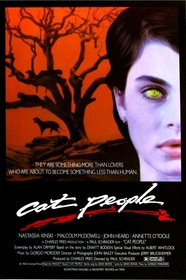
It's interesting to note that this film was made just one year after An American Werewolf in London, just as the original followed The Wolf Man by just a year. Both Cat films, I suspect, were made to cash in on their earlier lycanthropic counterparts. The difference here is that the 1942 version managed to at least equal Wolf Man in quality, while London remains to be topped.
The problem here is that the script does away with all the ambiguities about whether Irena (Nastassia Kinski) becomes a panther when aroused. Here, it's patently obvious that she does. Yet they still keep many plot points and scenes almost to the exact, and these become redundant without the uncertainty. Alas, in an attempt to have their cake and eat it too, the makers of this film end up with some stale dessert.
However, this is made up for with an interesting kink in the plot. Enter Paul (Malcolm McDowell), Irena's brother. He has come to the realization that the only way to avoid becoming a panther after sex is incest. Apparently, two cat people can't bring out the beast in each other. McDowell's portrayal here is menacing as hell, as if he could kill you or cuddle you at any moment (both are very, very dangerous). It's a shame he doesn't have more screen time.
The rest of the acting is blah. John Heard plays a bland hero and Annette O'Toole a bland love interest. Kinski does a little better, but much of her performance plays off her own exotic beauty, rather than any actual talent (which I'm sure she has, hidden somewhere). She does confused, aroused, and scared pretty well, but emotions like 'happy' and 'enthusiastic' seem beyond her grasp. Luckily, she doesn't have work with those much here.
Violence in this film is, for the most part, suggested. However, this is only to make room for the gratuitous shots of Pothole and Kinski topless and/or naked. Thank you, you have lovely bodies. We understand. Put your clothes back on. I mean, I like female nudity as much as the next heterosexual guy, but the amount of flesh in this film was ridiculous! Do you have to swim naked at the YWCA? Is it a requirement to strip nude when you go outside for a stroll in the middle of the night?
Everything taken into consideration, this isn't a horrible movie. At its best moments, its really creepy or really erotic. However, it could have been better. To do justice to the original, it should have been better. Otherwise, what's the point? A decent rental.









Best movie I ever saw!
Best movie I ever saw!