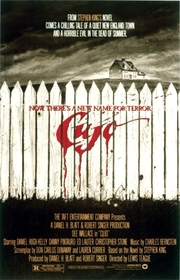
Vacillating between moments of excellence and moments of extreme mediocrity, Cujo is enjoyable but ultimately a bit disappointing.
Dee Wallace (who plays a fine genre mom -- she was the mom in E.T., also) is Donna Trenton (no she doesn't have a New Jersey-ite accent or hairdo), wife, mother and philanderer. She has a twinge of uneasiness about her. Whether she is under or overreacting to philanderer guilt is debatable. It could also be indigestion.
In any event, the first half hour or so introduces us to Donna, her advertising executive husband Vic, who plays the part as if he's a minute-hand short of a clock, her son Tad, who we learn is afraid of monsters, and the other necessary characters, including the "town stud" Steve Kemp (I can't imagine any woman then or now calling him a stud--maybe they meant another "s" word usually reserved for females), and the hillibilly mechanics and all-important dog (Cujo himself) owners, the Cambers.
Now maybe I'm being a bit too sarcastic, but the exposition is the extremely mediocre part--in fact, it almost borders on "so bad, it's good." Unfortunately, it's not quite that cheesy, but it is easy to poke holes in. It has also dated very badly--the film itself, the direction, and especially the music all scream "low-budget early 80s." The music, setting, etc. give the "fate" scene--the opening sequence of Cujo sticking his nose where it doesn't belong--more of a Lassie feel. Of course, that was the intent--to underscore Cujo's transformation and contrast the beginning with the excellent part of this film.
To a large extent, everything in the film seems like an excuse to get to the payoff, which is an extended scene that I won't go into detail about, lest I give fatal spoilers. Everything about the payoff is excellent--it is beautifully photographed, well-directed, amazingly acted, tense, scary, etc. It's also at least half of the film, and it saves Cujo from a 5 rating or worse.
Engaging in fantasy for a moment and pretending that I was Cujo's producer -- and assuming I could get Cujo novel writer Stephen King to agree -- I would have suggested the following. Cut all the junk about Donna's affair, about her husband's job, etc. Hell -- cut the entire beginning of the film out! Instead, start the film with Donna driving up to the Camber's place and get right to the payoff scene, which could have been extended so that it was the whole film. Any background on characters that we might have desired could have been achieved through monologues by Donna as she reflects -- maybe she happened to have a tape recorder in the car and wanted to record her story for posterity just in case she doesn't make it. That would have been a great film.
Maybe I'm not giving the material credit, though. Maybe there is a way to effectively incorporate the exposition -- Stephen King did a fine enough job in the novel. As it stands, though, the beginning of the film just doesn't work with the main thrust.
I know all the critics who desire establishment respect clamor for character development, but most of the character development in Cujo is unnecessary, not that interesting, and pretty irrelevant to the point of the film, and it's a brilliantly simple goal -- to make you terrified of a dog. That goal is reached, and we don't need anything else. Unfortunately it is compromised and that makes this an inferior Stephen King film.
Trivia:
In order to get the dogs to attack the car,
their favorite toys would be put inside, and the animals would
try to get them.
Cujo was played at various times by one of five actual dogs, a mechanical head, or a man in
a suit.








More Trivia:The producers had
More Trivia:
The producers had to tie the dog's tail to his leg. During the attack scenes, the dog was having such a good time playing with the actors he kept wagging his tail!