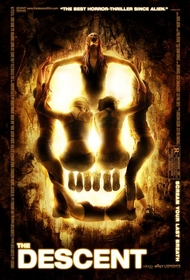
The Descent could be seen as a
textbook guide to instilling horror in viewers. However, to view
this film in such a way would be to consider it a mere genre exercise
when instead it is a jarring metaphor for the pain of exploring our
darkest thoughts. The horror here, which is accomplished as
perfectly as it likely could have been, does not exist solely to
frighten but to evoke the terror of such a journey into the
subconscious. Specifically, the film follows one character's
descent into an unexplored cave system, which almost inherently
becomes a metaphorical descent into the unexplored recesses of her
own mind. The Descent is merciless, but more importantly, it
never falters from its attempt to tell the story of a character's
confrontation of the hidden aspects of her psychology.
An outdoor sportswoman named Sarah
loses her husband and daughter in a car wreck. Her husband, who was
driving, seemed lost in thought at the time. The film hints that he
was involved with one of Sarah's outdoor companions, Juno. Some
time after recovering from her own physical and emotional injuries
incurred in the accident, Sarah heads out on another trip with her
friends, this time to go spelunking. While on this expedition,
getting lost is only the beginning of their problems. These six
women will soon encounter an unimaginable terror.
Throughout the majority of the film,
there is never a suggestion that Sarah suspects Juno of being
involved with her husband, but that's likely because she doesn't
want to consider that thought. However, one early scene shows us
that there is some unexplored idea within Sarah's psyche that she
does not want to confront. During her recovery in the hospital,
Sarah wakes, walks into the hallway, and hallucinates the hall's
lights going out one at a time. As they do so, Sarah flees the
approaching darkness as if it contained something terrifying.
Whether it is a belief concerning Juno or something else entirely,
there is something devastating within Sarah's subconscious that she
does not want to acknowledge.
Whereas the hallway hallucination is a
visual symbol of something haunting Sarah's deepest thoughts,
Sarah's descent into the cave is a metaphor for her descent into
her subconscious, her slow confrontation of her suspicions. This is
where the horror begins. As Sarah and the others delve deeper into
the cave system, they encounter worse and worse horrors. First, it
is the simple knowledge that they cannot return the way they came.
Then, it is a brush with death, as Sarah becomes stuck in a
crawlspace and nearly crushed to death. Later, the characters learn
that Juno, who was supposed to bring a book detailing safe passage
through the system, not only left the book behind but took them to a
different cave altogether -- one that has never been explored.
Finally, the women are confronted by a primordial horror that could
not have been anticipated (and which is best left unspoiled).
It is upon this final confrontation
that Sarah metaphorically reaches her subconscious, the place likely
harboring her suspicions of her husband and Juno, and struggles to
keep it from destroying her. The horror is everywhere, from jump
scares to the nature of the threat itself to the fear of dying a
barbaric death far beneath the Earth's surface. Eventually Sarah
hits rock bottom of the cave system, when she becomes completely
submersed in the blood of other victims that have fallen to the
terror facing her. This is a turning point for the character, as she
has symbolically succumbed to the deepest crevasse of her psyche. At
this point in the film, she acknowledges and even begins to embrace
every gritty aspect of her being. When she performs one act that
confirms the evolution of her mindset, she is freed from the
suppression of her un-approached thoughts regarding her husband and
friend, and, in a two-part final scene, she begins to experience
dreams of wish-fulfillment rather than nightmares of suppressed
thoughts. There is a nightmarish entity that pops up in one of these
dreams, but it is not an indication of her returning fear. Rather,
it is a sign that Sarah has fully accepted herself and all of her
actions. This otherwise startling element is present in her dream
only because Sarah no longer fears it. In fact, she may no longer
fear anything.
In the end, The Descent's
subconscious-born horror is really the horror of accepting oneself in
full. Sarah's thoughts about her husband and Juno always existed
within her, just as the more real horror she encounters always
existed below the surface. When we acknowledge buried aspects of our
being, as Sarah does her own, we accept the parts of ourselves--the
thoughts, the suspicions, the ideas--that have been buried beyond our
conscious. However, to loose such things into our being means to
invite mayhem. There are some parts of ourselves that we are not
prepared to face. It may be that accepting them is the only way to
live authentically, but if that is the case, authenticity may be
something we can do without.