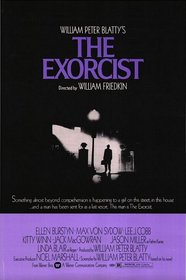
I cannot stand listening to either William Friedkin or William Peter Blatty talk about The Exorcist. They have a tendency to speak at great length, not about what they intended, but what the film means to audiences everywhere. How it shakes the foundations of their faith, makes them question their reality, and turns their view of good and evil on its head. It sounds very nice, but even assuming that what Friedken and Blatty say is true, such statements limit the effectiveness of The Exorcist specifically to those people with a strong monotheistic religious bearing. Personally, however, I find it difficult to recommend the film to much of anybody.
The problem with The Exorcist is that it's a horror film made by someone in denial of the genre. It's never a good thing to outright deny the type of film you're making. The film will still be made, but it's either going to apologize for itself constantly or it's going to emphasize all the wrong things. The Exorcist does both.
Regan MacNeil (Linda Blair), the twelve-year-old daughter of actress Chris MacNeil (Ellen Burstyn), hasn't been feeling too well lately. In fact, she's taken to urinating at her mother's parties, flailing violently, and screaming obscenities. Chris seeks medical and psychological help at every level, but when Regan's bed begins bucking of its own accord and random items fly about the room, it's obvious that the problem isn't in Regan's body or mind, but in her soul. Some demon (or the devil himself) has taken hold, and it won't let go until she's dead and rotting her grave. Desperate, she contacts troubled, self-doubting priest-cum-psychiatrist Father Karras for an exorcism. Karras, in turn, calls the only man alive to have performed a successful exorcism, the wizened Father Merrin (Max von Sydow).
Breaking down The Exorcist shot-by-shot would actually reveal a treasure trove of directorial moves. There's no disputing that the director Friedkin is talented -- one need only watch The French Connection to know that, and there are a few sequences in The Exorcist that also attest to his skill. Observe the scene where Detective Kinderman (Lee J. Cobb) questions Chris MacNeil regarding a murder that took place in Regan's room. Note how the camera closes in and pulls out on the two participants, and the see-saw of meanings that the movement takes for each (a push in is a trapping box for MacNeil, but a rapidly approaching clue for the detective, for instance).
Such intricate analysis is only useful when the film being scrutinized is worthy of it. Sadly, The Exorcist is not. For all the shots worthy of diagramming, they just don't hold up a story. Friedkin's oft-celebrated "documentarian" approach to the subject matter leaves gaping holes in character arcs or strands our interest in a muddle of mundane dialogue. Often the film will simply shift moods, pulling us from one scene of high emotion (Regan writhing and screaming) to another vastly understated one (Father Karras jogging and discussing movies with Detective Kinderman). These shifts disrupt the momentum, jarring whatever tenuous hold the film had built since the last mood shift. Further, most scenes that take place without Regan are so understated that it's difficult to believe that the characters are dealing with such a overwhelming supernatural problem.
The understatements only serve to highlight and magnify the vulgarities of the "devil" scenes. The possessed Regan spins her head 180°, smacks her mother in the face, and masturbates with a crucifix, all while screaming phrases like "Let Jesus f**k you" and "Your mother sucks c**ks in hell." I may have a strange sense of humor, but I find that sort of thing very funny coming from a pre-teen, even one in grotesque Dick Smith makeup. She even spews green pea soup. We usually only get that kind of action in splatstick comedies. Sadly, Friedkin and screenwriter Blatty (who also wrote the original novel) cannot see the humor in what they create, nor do they seek to create melodrama by giving the devil some purpose for his gibberish. The few times we see an unpossessed Regan, she is such a blank personality that it is impossible to be too concerned for her well-being. The result of all of the above is that Regan MacNeil, possessed girl, becomes nothing more than a cacophony of pseudo-horrific blather, blaring so loudly above the otherwise low-key soundtrack that she becomes incomprehensible.
What's worse than that is what Regan's possession represents to the horror genre as a whole. The being inside Regan is the Devil, Satan himself. Not only that, but Old Scratch appears to have no plan. He just wants to sit inside the little girl until she dies. Since he shows himself to be perfectly capable of escape should it become necessary, the fact that he lies in wait of an exorcism seems, well... stupid. Basically, Friedkin and Blatty have taken the Big Bad, the Ultimate Evil and they've made him into a ridiculous fool who corrupts the body of a pre-teen girl for poops and giggles. While that's all well and good for his ultimate defeat (so to speak), it doesn't do much for the genre itself. Good horror typically requires a credible threat. If you go and make a concentrated statement with millions of dollars of backing that not only is the Devil weak, but he's also stupid, you hamper the effectiveness of our villains. One could argue that Friedkin's undercutting of horror's most mythologically powerful antagonist directly contributed to the rise of the slasher genre later in the same decade.
There is, however, an argument to be made that Satan actually has a plan. The argument relies heavily on the fact that Friedkin spends the first 10 minutes of the film following Merrin as he discovers portents of evil in Northern Iraq. The sequence does not appear to have much to do with the film as a whole, although it is unsettling occasionally, if only because xenophobia is difficult habit to shake. It is possible that this prologue is in fact the only truly significant part of the film, as it speaks to the Devil's true intent -- the murder of Father Merrin during Regan's exorcism. The Devil's constant cries of Merrin's name during emotional duress further support this theory. However, accepting it leaves the film with two major problems. One, most of the character-driven scenes that take place outside of Regan's bedroom become useless and inert. Second, it raises the question of why we are being presented a film about the fulfillment of a long-held grudge without getting much detail on the grudge's origin.
It would be foolish of me not to acknowledge that my thoughts here fly in the face of most common critical wisdom. I am aware of The Exorcist's vaunted position in the history of horror. I am not denying that it holds power for thousands, even millions across the world. For that fact alone, it should be viewed with some amount of reverence, if only to acknowledge its overall effect on what was to come. I feel largely the same about Friday the 13th. That I cannot recommend the film personally does not mean that it is without merit. If this seems a contradiction of what I've said before, then very well, I contradict myself. The genre is large, it contains multitudes1.
With apologies to Walt Whitman
Trivia:
Jane Fonda and Shirley MacLaine were approached to play the mother role that eventually went to Ellen Burstyn.









For someone so up to scratch
For someone so up to scratch on film, you've missed a pretty glaring part of the plot - that being that it's not in fact the Devil but a demon named Pazuzu that's possessing Regan.
Pazuzu is something from the
Pazuzu is something from the book and isn't really referenced, except very obliquely, in the film. Certainly, Exorcist II: The Heretic brought Pazuzu back in, but Friedkin's focus appears to be on the devil himself in the first film. I'll take him at his implied word -- it's the devil in there.
"He went for a little walk! You should have seen his face!"
the exorcist is a landmark
the exorcist is a landmark film...one of the best. a young girl forced and driven to vile acts is only funny to a child...the above review is pathetic
The fact you use big words
The fact you use big words does not make your point any better this is just a child trying to get some attention.
Just because you pan a critically acclaimed film it doesn't make you better than everyone. The Exorcist will always remain a classic and has withstood the test of time will you? No you will be long gone before The Exorcist is even celebrating 50 years of glory.
It's not just the panning it's the awful style you have written in, it's arrogant and obnoxious. You don't talk down to your readers you talk to them in a friendly yet professional way it is not that difficult to achieve but yes you only did this to be controversial and it has achieved nothing because this site is pitiful. It's called classic horror and Eight Legged Freaks is on here, it is laughable.
Get some perspective or move along there are lots of us who achieve a lot better than you do.
I'm getting that you disagree
I'm getting that you disagree with me. What I don't get is why a review from someone you clearly see as unqualified would elicit such an angry response.
I am more than a little offended at the suggestion that I would write a review just to engender controversy. I dispense my opinions. You can disagree with them, but don't cast aspersions on my motives.
"He went for a little walk! You should have seen his face!"
You fail to see that? My oh
You fail to see that? My oh my. Why wouldn't someone get angry at a review like this? Ebert would be ashamed of you.
Of course you would write a review just to gather popularity it is a blatant thing from just taking one small looking at this review, you are pretentious if you were to calm that down then maybe just maybe I could take you that bit more seriously. You have no right to act in that way.
I think the above response is
I think the above response is a little harsh. From my reading of Nate's review it was neither condescending nor did I feel that he deliberately courted controversy for the sake of attention. The Exorcist is a film that is often referred to as ‘classic’ so it’s to Nate’s credit that he refuses to treat it as a sacred cow. Films should be discussed and engaging with people with contrary opinions is part of the fun. Often times this can allow you to examine a film from a perspective you hadn’t previously – which surely is a good thing.
And yes, “your mother sucks cocks in hell” is pretty funny!
I'm in total agreement with
I'm in total agreement with Tom on this. And I'm saddened, and more than a little shocked at the level of vitriol in some of the other posts. There is absolutely nothing in Nate's review to suggest that he is attempting to condescend, or garner attention. His review is well-written and thoughtful. He provides concrete examples of where, he felt, the film succeeded, and where, he felt, it ultimately failed. It certainly provided me with a perspective I hadn't considered before, and I thank him for that. I don't visit this site to see my own opinions celebrated. I visit this site to read thoroughly-researched, well-written, and yes, sometimes provocative ideas. I don't always agree with what is written, but I certainly don't consider a difference of opinion to be a personal attack on myself. And when I do voice my difference of opinion - I focus on the film, not on the reviewer. To do otherwise is not only uncalled for - it is churlish, and it is childish..
There is a preachy tone to
There is a preachy tone to this review. I have shown it to many of my colleagues and they all agree with me on this and not because it was me showing it, I let them read and they came back to me with the same feedback.
Plus you missed out the sick nature of this film, it is a child being violated, in a sense raped, by an external force and how on Earth is that funny in any way shape or form? It is sick and supposed to emit disgust and fear into you if you are watching in a comical and twisted way then yes the film will be ruined. Jeez, seriously let's see your children go through something like this it wouldn't be so funny then would it that is what is at the core of the Exorcist along with the age old Good Vs. Evil. It even makes non-religious folk realise the true meaning of the Bible the message it is trying to send, forget about the ridiculous claims look at the message Good will succeed if we want it to and yes Evil lives in this world and it always will but we do not have to let it succeed, look at the layers a bit more observantly and then you'll see why it seen as the greatest Horror of all time, I wouldn't call it that because I personally believe Suspiria to be better than this but it is a masterpiece and does not deserve be mocked in the ways it has been and it has influenced many fantastic directors which we must also thank it for.
When reading a review one must take the style and tone into consideration, you must essentially review the review. Everyone has a separate opinion I understand that so you can't bash an opinion per se but this review could have come across a lot less arrogant could it not? Why would I and others think it was arrogant if it wasn't there must be a hint or a shred in there at least.
But yes I agree with your Friday the 13th comment, see there's the olive branch.
I'm aware my opinion on The
I'm aware my opinion on The Exorcist is not within the norm. I'm also aware (as the last paragraph attests) that there are aspects of the film that speak to a great number of people, even as I do not see them. What you see as arrogance, I see as being assertive. Just my opinion, of course, but that's all I have and that's all the review is.
As for the child's violation/rape... given the number of mechanical apparatuses, body doubles, and voice doubles employed (and their over-the-top usage), it's very difficult for me to see Regan as a child rather than a special effect (and hey, I never thought about it in those terms before, so thanks for taking the time to discuss some of the specific points).
Strict good vs. evil has never been something that particularly resonates with me. I don't believe in evil and, unless we're talking light fantasy, pure evil in the movies doesn't interest me. Even demons, should they exist, probably have goals and ideals and personal motivations and I find that fascinating.
"He went for a little walk! You should have seen his face!"
I always felt The Exorcist
I always felt The Exorcist was overhyped and a little disappointing, but I never could put my finger on why exactly. Of course - it's because it's so pointless of the devil to possess a girl's body and then just sit there waiting to be exorcised. Thanks for a very perceptive and thought-provoking review. And to Jeff Phantom: chill, dude.
There is nothing wrong with
There is nothing wrong with this review's tone or the site in general because it reviews less bonified classic films and explores newer material like Eight Legged Freaks here and there. Thats just doctoring up the recipe a pinch and prevents a site from getting itself stuck in a corner.
But since this topic is on the table I have to admit that I have always felt some distance between myself and the film after the 1st viewing. I saw it some ten years or more after it was released and I was the only person in the theater for an afternoon matinee and to be honest a tad bit stoned. For first viewing it seemed like a pretty decent film and I still think it is worth an occasional rewatch. But the last time I watched it I again had this feeling that I could not really follow why somethings were doen the way they were done. I tend not to analzye films and their messages and the motives of the creators too deeply. Just my style. But I just felt the film was too slow and spacy at points and seemed to be leaning more towards being a melodrama than a horror film most of the time. My favorite parts of the film wind up NOT being the scenes of Regan spewing forth pea soup but the scenes of, for example, Father Karras struggling with his faith and suffering over his mother's death. The long sequence with Regan tied to the bed and bantering with Karras and then later Merrin only lend themselves to later parody and satire as was done to good effect with James Woods in one of those atrocious Scary MOvie films.
If a person were a devotely religious person then the film would no doubt be 'shocking and controversial' and especially given the time it was released in when movie viewers had not yet become so jaded with blasphemy or one sort or another thrown in their faces, no doubt in some ways because of The Exorcist's influence. It is not this review that becomes arrogant and preachy but the film itself and certainly Friedkin has done films I like much more. His next major film Sorcerer (1977) shows Friedkin at work in his element more than The Exorcist did.
I know it's a little old but
I know it's a little old but I wanted to throw my two cents in about this film. It's funny because Nate's review is actually quite good. I don't have any complaints with his writing and I fully respect his right to disagree with how great the film is. I do think though that he has missed part of the point of The Exorcist. Having had the chance to meet screenwriter Blatty at a convention once I was able to ask him a few questions about the film. And as far as he's concerend it's not the Devil himself that's posseing Regan. Rather it could be any one of a number of lesser spirits. Even on first viewing I never thought it was the Devil himself. The idea that he would lower himself to control one girl is absurd. Even the Bible mentions lesser evil spirits possessing people but never the Devil himself. Of course the demon would say that it was the Devil just to fuck with them. The fact is that everything it says is up for debate so you're not supposed to take what it says at face value.
Which brings up the second point. The idea of assigning a purpose to evil, as we might think of a purpose or goal, is to romantize the very concept of evil. Evil is petty, spiteful, and small minded. There are several examples of this in the real world even if you're not a Christan scholar. But since I am a Christan as well as a lover of horror films (which is not really as strange as you night think) I have to direct your attention to famed author C.S.Lewis's book, Perelandra. In the book the main charctaer, Ransom, faces off against a possesed villan (fittingly Lewis calls him the Un-Man). The Un-Man does not attack him physically but torments him endlessly simply by calling his name over and over, seemingly without reason.
As Lewis puts it "What chilled and almost cowed him was the union of malice with something nearly childish. ...for a whole battery of horrors, he was prepared: but hardly for this petty, nagging as of a nasty little boy...deep within, when every veil had been pierced, was there, after all, nothing but a black puerility, an aimless empty spitefulness content to sate itself with the smallest cruelties, as love does the smallest kindness?" Or as Father Merrin tells Karras, maybe the demons goal is to make those around it question their fath. To make them feel small and worthless. The threat in this film is very real. It's a spirtual threat, which I find far more disturbing than any physical one.
As for mood changes ect, I can understand where you're coming from but after awhile you become used to the flow of the film and it doesn't really matter. In fact I found the down time after the violent scenes to be an intersting contrast and to provide a bit of a breather as well. I guess it depends on how much you're into the film. By the same token I could point out the fact that Suspiria"s heavyhanded soundtrack (with the chants of "Witch, Witch" all the time) helps disrupt the momentum of that film as well, but plenty of people have no problem with that aspect of the movie.
I also have to praise the film for not answering every question for the viewer. As famed director Nicholas Meyer pointed out in his great commentary to Star Trek 2, there is a horrible tendancy for Hollywood to spoon feed us the answers. Every t has to be crossed and every i has to be dotted. As with every form of classic art, paintings, music, ect, what you don't see is as important as what you do see. I'm sure you know this but it's good to be reminded of this fact sometimes especially in this day and age of movies like Transformers, ect.
Well I think I've gone on long enough (besides you may not even get around to reading this). I think it's clear that I have a great respect and love for this film and while it may be a bit predictable to say this, I really do feel that it's impossible to overestimate The Exorcist's importance on horror films, and cinema in general. Thanks for everyone's time! Kellin W.
While I don't disagree with
While I don't disagree with some of Nate's review I think he's a little harsh. Sure "The Exorcist" has its faults but what film doesn't? The film is out to scare the hell out of you---and it does! Trying to "see" what this film is saying is kind of silly. It it scares you it works. If it doesn't then it doesn't work--simple as that.
Two points I think he's WAY off base with--Regan was masturbating with a crucifix???? Really???? Looks to me like she was stabbing herself with it--not masterbating.
The other is you think it's the Devil himself. That's NEVER made clear. It says it is but--as Father Merrian says--it's a liar. In the second film u find out it was Pazuzu.
And I'm surprised that u didn't mention one point that has always confused me---Regan breaks her neck TWICE and is OK when it leaves her. Are we supposed to believe that the demon broke her neck, repaired it, broke it again and repaired it again?
Anyone that gives "Hatchet" a
Anyone that gives "Hatchet" a thumbs up and "The Exorcist" a thumbs down just lost all credibility. I now know there is no need to read any of your other reviews.
THE EXORCIST has always been
THE EXORCIST has always been one of my favorites. Looking back on the often hysterical reactions to its initial release, I am particularly amused by the mostly negative critical response which Nate Yapp seems to echo. They almost in unison dismissed it as a simple minded "blood and thunder" horror film with nothing to recommend it. For many years, I had concentrated on both Linda Blair and Jason Miller, two actors with little screen experience, but now viewed the 2000 remix with a different perspective. Yes, the early scenes depicting the relationship between mother and daughter might seem mundane to many critics, but surely the everyday activities of just such a tandem would appear that way to non family members. Young Regan is fortunate she cannot remember what happened, so the real tragedy is the plight of Ellen Burstyn's mother, deservedly top billed. Such a loving, caring parent suddenly confronted with an inexplicable occurence that leaves her stunned and vulnerable. When the first doctor advises her not to worry, her understandable reply is, "how?" It's not so much an ordeal for the child as it is for the mother, especially with the realization that "that thing upstairs," that was once her daughter, is responsible for killing her friend Burke Dennings. The demon's statue seen in Iraq has a huge phallus, and much has been made of it's rape of the pre teen girl, both physically and spiritually, but add to this the hopelessness experienced by the mother, and the film's focus is far more wide reaching than any self proclaimed critic has ever acknowledged.
I'm going to have to agree
I'm going to have to agree with the more vitriolic comments agains Nate's review of The Exorcist. I agree that when Friedkin and Blatty get into a room to discuss their film, they come off as sounding a bit self-involved, and seemed to have missed the point of their own movie. This was a giant hit, and both seem(ed) more concerned with making clear what they were responsible for, and what the other was not. And yet this has absolutely nothing to do with the movie itself. So why is it opening this review? Perhaps because the pompousness of the producers, and the extreme success of the movie, tears it away from the cultish world of horror movies? Just a guess.
I disagree with Nate on the fact that just because this film was successful and continues to be well-regarded, that it should be watched with reverence. I don't go into a movie respecting it or revering it--that would be ridiculous: I must watch the movie before holding such strong opinions.
That's the thing. There is a lot of writing here about the circumstances surrounding the movie. A ton, considering that this review should really spend it's time explaining why a movie so good is actually so bad and unrecommendable, (in your opinion.)
While I commend Nate for expressing his dissenting opinion, I just wish he had stronger arguments to support why he couldn't recommend this movie, one that has transcended its genre and reached many more than just horror fans, while he has no problem recommending Hatchet--an awesome B movie with great gags, to be sure, but certainly nothing even approaching the minor leagues of what The Exorcist does, or even just is trying, to do.
I read the review above and
I read the review above and it is...well..a little too harsh. I personally loved this movie! I think it is more of a tragic love story than a horror. Sure it has its scary moments that made people faint, vomited, and scared shitless when it came out in theaters, but if you really think about it. The priest Karras was willing to sacrifice himself to the demon then have Regan be killed near the end, even though he didn't know the girl at all! I was crying when that happened because I am very emotional when it comes to that. Plus, the dude who wrote the review you can't tell us it is a horror movie everyone is entitled to their opinion just because you think the movie sucked, insulted the creator, and was harsh doesn't mean we have to think it is a horror movie! >:( I think it is a tragic love story that is really well made. Oh! Plus, that part when the demon waited for the Exorcism didn't ever occured to you that maybe the demon knew that Father Merrain was coming to help Regan?!? So...ya I love this movie and I am going to watch it right now!!! :D
First of all, all opinions on
First of all, all opinions on art are subjective, so it is hard to contradict an opinion as long as it is based on "feeling" rather than facts or logic. So it is also hard to dismiss criticism of a classic like "The Exorcist".
Having said that, alarm bells go off with me when a website dedicated to horror movies basically pans a movie like "The Exorcist". I could point at lesser movies being praised, but that would be missing the point, as it is not about how other movies are worse than the critic thinks, but specifically why he thinks The Exorcist is a bad movie.
So how about an analysis and my opinion on the review:
Thinks get off to a bad start when a movie review starts with the critic's proclamation about his dislike for any particular actor, writer or director, because none of that has anything to do with the quality of the movie itself. It therefore begs the question why the critic even mentions it, since it seems to expose a negative agenda from the start. Seriously, who cares how you feel about the writer or director? It is a review of the movie, is it not? Not about the commentary of crew members. I have the same problem with Richard Scheib's review of Peter Jackson's movies post-LotR, because in one of those reviews he goes into a rant about how he dislikes Jackson's politics concerning unions. Why even bring it up if it is a review about the movie?
Now, i understand that for somebody who does not like the movie it is hard for him to recommend it to anybody, but isn't this really ignoring the fact that the critic is in such a blatant minority? How can you even really say you cannot recommend it to anybody, when so many people clearly love the movie? Basically, it would be saying you would rather deprive others of a genuine classic, just because you "don't get it".
The comment that The Exorcist is a horror film made by someone in denial of the genre seems completely arbitrary and irrelevant. First of all, The Exorcist is recognized as a horror classic by genre fans and non-genre fans alike. How can a movie in "denial" of the genre be classified a classic? But even if it was, what is the point being made? The Exorcist is a movie, plain and simple. Who cares if it, in the critic's view, is made by someone in denial of "the genre"? People take it as they do, and they took it as a marvelous movie, period. Why patter about "denial of the genre"? Again, this comment seems arbitary and meaningless. It seems a comment that makes no statement whatsoever about the content of the movie itself.
Now, let's forget for a moment that the critic collectivizes his criticism by speaking of "we" instead of merely himself, his criticism of character arcs and mundane dialogue can easily fall on deaf ears. I personally saw no problem with character arcs, and honestly, a critique of "character arcs" on a horror movie website? As Ridley Scott once said after criticism of characterization in his Alien (1979), "that is not what the doctor ordered." You know all you really need to. But Friedkin gave me more than i needed to, so i fail to see any point. About the mundane dialogue. That's how normal people speak. They speak mundanely. They don't put their every utterance in the service of furthering some unseen plot, and don't speak like eloquent literary characters that are trying to help the screenwriters win an Academy Award, either. Thank god for "mundane" dialogue.
The critic then complains about mood shifts. Going from full-on hysteria to a calm scene. But first of all, different characters are in vastly different situations, therefor the shifts are normal unless you want to spend 120 minutes with a girl vomiting and uttering profanities and her mother screaming her lungs out. Second of all, the mood shift make the disturbing scenes so stark. That tonal difference helps to convey just how bad the situation with Regan truly is, by countering it with ordinary conversations between blissfully unaware people. This tonal shift seems to be a problem to the critic, but once again the criticism seems to be arbitrary, as if it easy for others such as myself to see precisely what the point of the "mood shifts" is. Would the Exorcist have been better to the critic had it been a 120 minute scream fest (thereby creating tonal consistency) ? Maybe, but i can see how this classic would have turned into an actual overblown show of theatrics to the people who now deem it a classic.
"The understatements only serve to highlight and magnify the vulgarities of the "devil" scenes."
So apparently the critic DOES get the point, but sees it as a point of criticism. And this is why i cannot really take this review seriously. The vulgarities should be highlighted, precisely because the point is to show the extent of the evil that has taken over an innocent pre-teen girl.
The critic then destroys the rest of his credibility at least as far as this review is concerned by thinking that the vulgarities are "funny" because a 12 year old girl utters them, even though this is precisely what is horrifying about it. Remember also that she is screaming it against a man who just lost his mother and is wrecked by guilt. The notion that his mother is "in hell" performing sexual acts is not at all funny in the context of the character of Father Karras. But one would actually have to invest oneself in the movie to see this. Anyway, maybe the critic would have felt it to be more horrifying had the girl sung "My Little Pony"? Just because the critic is stunted to such language does not make it a valid criticism of the movie. Also, the notion that one does not care about the fate of the girl because her character is blank is typical movie critic BS. Does this mean one is also indifferent to the fate of, say, autistic girls? Of to the fate of girls he hardly knows at all? Not only is the girl not "blank" (although little time has been spent on presenting her in "normal" state), it is somehow sociopathic to use this as an excuse not to care for her well-being. However slight she is presented, she is obviously presented as a sweet and innocent 12 year old girl, and that should really be enough to any normal human being to be able to sympathize with her plight. And again, how many horror movies, exactly, flesh out their characters? Does this stop the critic from praising 95% of all horror movies? If not, Then why criticise The Exorcist for it? Furthermore, the critic thinks it is sad that Friedkin does not see the humor in it. I find it really sad that the critic does. Very few people do. Chalk that up not as criticism of the movie, but of the critic.
"What's worse than that is what Regan's possession represents to the horror genre as a whole. The being inside Regan is the Devil, Satan himself."
To my recollection this is never stated as such, and the critic's interpretation of non-presented information is meaningless.
Other comments have already explained the nature of evil, and therefor no more really needs to be said about the demon having "no plans". Corruption of innocence *is* his plan. And to my recollection at least three people have died, including two "men of faith", one of which is the arch-enemy of the demon. To stress the point further, take another classic "Rosemary's Baby". The only point there, by the critic's logic, is to make sure the demon baby was born. Well, so what? Since we don't see or know what this will mean to the world at large, does this mean the horror movie presents no villain worthy enough to make the movie qua horror movie a failure?
The critic makes some off-hand comment about "xenophobia" regarding the Iraq-segment of the movie. This seems to confirm my suspicion that political correctness goes where it is thrusted by force, because in none of any of the times that i watched The Exorcist did i see any slight whatsoever to Iraqi people or culture. And nowhere else did i ever hear any remarks about any supposed "xenophobia" in that scene. Maybe the critic meant something else, but the sarcastic tone seems to suggest otherwise.
We have two more irrelevant complaints:
"However, accepting it leaves the film with two major problems. One, most of the character-driven scenes that take place outside of Regan's bedroom become useless and inert"
This is ONLY if one assume that no movie may present conflicts, fears and dangers to characters other than the one directly involved. There is no case to be made for this other than pure personal and arbitrary opinion. The scenes outside of Regan's bedroom are obviously NOT useless and inert to all of the people that felt affected by the movie. And that in itself disproves the critic's point. The point was to get people involved with the plight of Regan, her mother, the detective, Father Karras and, yes, Father Merrin. It did so, succesfully.
"Second, it raises the question of why we are being presented a film about the fulfillment of a long-held grudge without getting much detail on the grudge's origin."
This is to assume that it is a given that details on the grudge's origin must be spoonfed to the audience, Why not simply take something as a given? Why not fill in the unknown with your own imagination? I've frankly never read that being spoonfed is actually the hallmark of a good movie. This must be a first.
Second, it raises the question of why we are being presented a film about the fulfillment of a long-held grudge without getting much detail on the grudge's origin.
So, as some people wisely say, to each his own, and everyone is entitled to his opinion. But so are those who disagree with the dissenter. I've tried an effort to explain why i think this review is based on quicksand, most of it consisting of subjective and arbitrary personal opinions rather than good arguments. What remains for me is the sad spectacle of such a great and classic horror movie being panned on, of all things, website dedicated to horror. I'm always open to good criticism, but none was found here.
I would rather someone make an attempt to show what an overrated piece of garbage a movie like "A History of Violence" really is (did i just become a rebel myself?).