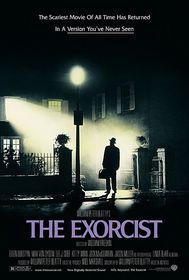
For a list of the cast and crew involved in this film, see our review of the original 1973 release.
Twenty-seven years down the pike, The Exorcist is still no easier to review. To many film fans, horror buffs or not, it is considered one of the best horror flicks, if not the best, period. It has certainly been influential in the genre, spawning everything from its own sequels, to other good series like The Omen, to not-so-good recent flicks like Bless the Child. Although it's not without its own influences -- such as Rosemary's Baby, The Exorcist will always be an important film historically, and as such, should be given at least one viewing by all fans.
However, perhaps because it is continually given such accolades, often while discrediting other films, and occasionally is the subject of such outrageous claims -- sometimes from self-proclaimed horror fans nonetheless -- as "The Exorcist was the last good/real/scary/etc. horror film made; everything after it is garbage," I tend to approach it with a hyper-critical eye that I wouldn't cast on, say, Critters 2. Under that hyper-critical eye, the last time I reviewed The Exorcist, I said it would deserve a 7.5 out of 10 if it existed in a cultural vacuum. After seeing the new cut (which is really closer to the original cut before director William Friedkin shortened it for its 1973 release), I'm actually tempted to rate it "so bad it's good." That may be too harsh, though, but maybe that's because I feel like I should like The Exorcist more than I do. I don't know; I can't see this film objectively any more.
I won't bother giving a synopsis here beyond "innocent girl is possessed by a demonic force and exorcists are called in" since we all know the story, so I'll start with some of my gripes:
- Just what is the deal, horror-wise, with the beginning, anyway? I never noticed this before, but it seems like Friedkin is a xenophobe. Most of the "creepiness" of the intro seems to center on Father Merrin (Max von Sydow {as a trivial side note, per the biographical information I found, von Sydow was only 44 or 45 when he made this film; he looks 74 - 75}) looking at Iraqis and getting freaked out by them. It mostly makes me wonder what Merrin doesn't like about, or at least what he finds disturbing about, the Iraqi culture. Of course there are the archaeological artifacts, too, but they're not very scary or creepy. And Merrin shouldn't think so, either, if he's really an archaeologist on the side. But, speaking of that, just why is he an archaeologist on the side, anyway? Oh yeah, and the dogs. Why are fighting dogs scary or even significant? Dogs don't normally fight?
- Once we settle in to Georgetown, any atmosphere that the beginning had going for it (and I do think there is some, it's just not particularly horrific--seen as something other than horror, I actually think the beginning is the best part of the film, but then again, I'm a sucker for archaeology and travelogue locations) evaporates and we begin a long, mostly boring stretch of excessive character development. I know most folks argue that character development is pretty essential, and I agree some is useful. The problem is that I never start to care about these characters, no matter how much development they're given. I find the bulk of Ellen Burstyn's performance, and Linda Blair's before she goes psycho, irritating rather than anything else. Some of the added footage makes this section of the film even worse--primarily the long, pointless dialogue between Regan (Blair) and her mom (Burstyn) about whether mom likes some guy.
- Speaking of pointless added footage, what was the deal with the scene where Father Karras is listening to Regan's birthday call with her dad? I was beginning to think that they just threw in any extra footage they could find, whether it helped the film or not.
- I also didn't care for most of the subliminal insertions--the flashing demon faces. They seemed designed to appeal to the MTV generation, which I don't think is inherently a bad thing to do, but a couple frames in a long, talky exposition aren't going to create that effect, they just make the film seem more ridiculous. The ghostly image of the Iraqi statue near the dresser was more passable. The actual appearance of the statue behind the bed at one point was the only one that worked for me.
- I don't know about you, but I burst out laughing at the first image of the desecrated Virgin Mary statue. I might have been the only psycho to do that--I know I was in my theater, which was crowded.
- I find the bulk of Regan's possession unintentionally funny. I think Sam Raimi realized this, too, and used it for one of the launching points of the Evil Dead films (which are masterpieces of the genre, in my opinion). Regan's profanities are funny to me in a similar way to, say, "South Park", and I could have sworn that one line -- the one that ended with "mf'er" -- belonged in a DeNiro film. Although I was the only one to laugh at the Mary statue, as the film went on my laughter (I couldn't help it) caught on. The spider walk scene was particularly funny, in context, and it's all the worse because the filmmakers were serious in what plays like outrageous camp.
- The added scene of Father Karras' mother in the mental hospital results in the line about Karras finding her dead at home making no sense.
- To me, the scariest scenes are the medical test sequences.
- What was the deal with Lt. Kinderman? He seemed to have some kind of priest fetish thing going. He kept asking them out on dates.
I could go on, but you get the idea of my hyper-critical gripes. There is a lot I enjoy about the film. As I mentioned, I do think the beginning is beautiful and atmospheric, but I don't think I get the effect Friedkin intended with it. I do enjoy the possession stuff, but as camp more than anything else. Other than Max von Sydow, who does a great job but doesn't get enough screen time, I like Jason Miller's performance the best, and the Father Damien scenes are the only ones I get anything close to the intended effect from.
I know that novelist and scriptwriter William Peter Blatty, in a Fangoria magazine interview (October 2000), said, "I always believed that removing the moral center of the film [referring to Friedkin's original cuts] actually limited its audience appeal. What I mean by that is that with the moral center, you didn't have to despise yourself for enjoying what you were seeing."
That may be the crux of the problem here. I don't despise myself for enjoying horror films. I don't need Blatty's conception of a moral center. The attempt to put those sorts of qualities in the film is unnecessary effluvia in my opinion.
So, I obviously don't think The Exorcist is a masterpiece, but it has its values, and if you haven't seen it at least once, you need to if you're a horror fan. The added footage both helps and hurts in places--more hurts, in my opinion. So, call me a heretic. Say I'm sacrilegious. Just wait to see what I do to your Virgin Mary statue when I visit with my Hellraiser bondage gear.








Father Merrin isn't acting
Father Merrin isn't acting xenophobic - he's feeling psychic distress. The dogs fighting are a symbol of chaos and disorder.
Nor is the dialogue pointless to me. I found the trivial chatter heightened the suspension of disbelief, and added to the impression that this was a typical American (post-nuclear) family
I recommend the excellent book, and the sequel, Legion.
Dude the mary statue is
Dude the mary statue is hilarious. But how can you call this movie "bad"? That's just bizarre, it's a thoroughly well-made movie.
I'm sorry, but some of your points are just not within reason, like "looking at Iraqis and getting freaked out by them." He's clearly going around treating the Iraqis like equals, speaking their language, working with them etc, and what's freaking him out is all the satanic s**t he's seeing obviously. Also, Father Karras listens to the tapes of Regan before she went mad because he's listening for any evidence of mental weirdness that may have led up to this, because they suspect she's just psychotic... obviously.
I think that when you're reviewing a movie that you've seen a hundred times, you really have to imagine how you would feel if you were watching it for the first time. The first time you see Exorcist, all of the rapid footage inserts are actually surprising; they catch you off guard and make the impression they intended. When you see it again you can make out the images better and see they're just a scary face or whatever. And man, this movie was made almost a decade before MTV was created.
I like the stair-crab part. The way she's upside down and backwards gave me a feeling like the panic attack sensation of everything being wrong and inverted. That's kind of hard to explain if you've never had a panic attack. Anyway it's very unique and disturbing but of course when you've seen it too many times it's only funny.
When I first saw this movie I appreciated the horror; now I just admire how artistic it is. It's kind of exhilarating. I seriously think the art just isn't to your taste. I don't get how you can let that bias you so much that you can suggest this isn't a solid movie or even a masterpiece.
Though I agree with you about how irrating Regan and Burstyn are in the beginning. It's unpleasant to watch.
The oddest thing about this
The oddest thing about this website's second dismissive review of THE EXORCIST is how this reviewer mistakes footage from the 1973 release as being from the 2000 reissue. That is too great an oversight for this to be a representative assessment of the longer, and in my opinion, better version (only one line of dialogue is missing from the 1973 original, so I quite enjoyed the fleshing out of many details).
For its time this movie may
For its time this movie may of been the scariest film ever made, as for now not so much. I love the exorcist very much but i personally think this movie is a bit overated. I live for horror and i have sat trough many other films i would consider more frightning and unsettleing. For example watch the Japanese guini pig series you would laugh next time you saw the exorcist. I will admit it has a few good scares the masturbation scene being one of them. But its just a product of the times i mean when it was made dracula scared people and today we watch it and wonder how were people scared by this. I have a feeling in a few years something new will come our way and than we will call that the next "scariest film ever made". Never the less though the exorsist is a must watch for any fan of horror and if it scares you well thats your own personal experiance, as for me its just a fun film to kick back and enjoy over and over again.