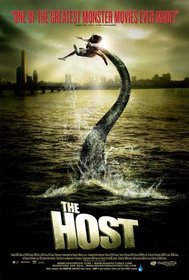
Bong Joon-ho’s The Host is the best political monster movie to come along since the original Gojira, but don’t think the film is content on being just a biting satire on government policies of both the United States and South Korea. No, there is so much more to uncover that each aspect of the film could be its own separate review. There is a subtle, almost dark comedic undertone to this movie, as well as a few scenes of poignant drama and sincerity. But above all else, it’s a serious horror film, a thriller packed with scares and screams as a result of an amphibious creature with a vicious temper and carnivorous tendencies. Don’t expect this monster to ever have a showdown with Mothra or King Kong. It just wouldn't be fair to those two.
In 2000, an American civilian mortician ordered his staff to pour over 120 liters of formaldehyde into the morgue’s plumbing system which led to the Han River, the main source of drinking water in Seoul, South Korea. That’s not the plot, that’s the truth. The Host rethinks this true event with much more disastrous results. There is still an American mortician (Scott Wilson) that orders a Korean underling to dump dusty bottles of formaldehyde into the morgue’s plumbing, but the end result is a creature (once a fish, now mutated from the chemicals) that dwells beneath a bridge that overlooks the Han River. One afternoon the creature comes ashore and snatches a small girl. That girl is Hyun-Seo (Ko A-Sung), of the Park family. Hee-Bong (Byun Hee-Bong) is a shop owner and the girl’s grandfather; his son, the girl’s deadbeat father, is Kang-Du (Song Kang-Ho), which is a particularly interesting name because it sounds like “can do.” Once the girl’s kidnapping (and apparent death) is reported in the news, Hee-Bong’s two estranged kids, Nam-Joo (Bae Doo-Na), a bronze medal archery champion, and Nam-Il (Park Hae-Il), an unemployed college dropout, come into town and join the Park clan in search of missing girl.
Perhaps the biggest challenge facing the Park clan isn’t the monster, but the opposing government forces that have taken control of the situation in South Korea. Bong Joon-ho, serving as the film’s co-screenwriter, depicts two government forces with missing ideals: the South Korean government is more focused on questioning and containing the contaminated townsfolk than it does on taking action while the American military force is more take-charge, launching a full-scale assault on the creature without asking questions. The Americans, however, do provide answers, as demonstrated when a news blip informs the public that the monster is carrying a disease that is similar to SARS epidemic. Meanwhile, the Korean government is insists, “let the news provide answers,” and in one of the best scenes of the movie, a government official in full hazmat gear enters a quarantine facility, walks to the center of the room, and trips and falls. Upon the film’s initial release, it was cited as being two anti-American, but Joon-ho, a native of Seoul, knows that it is two wrongs that don’t make a right, not just one.
Yet amidst the political aversion of the film, The Host fills the screen with thoughtful and meaningful performances that lend well to a theme within the film of unity among family. The Parks are eccentric to be sure but based entirely in reality. It is the performances of each member of the Park clan that allow their characters to ring true in the real world. Byun Hee-Bong, as the Park patriarch, brings a certain pride and honor to the role, but has the look of a beaten, bitter man that cannot tolerate his kids’ excessive fighting during times of grief. Song Kang-Ho, as the oldest son Kang-Du, has the dual responsibility of providing the film’s comic relief but convincing the audience that he is truly attempting to be a great father to his daughter; Kang-Ho succeeds because his doesn’t act the fool, but as a misguided and misunderstood father. Ko A-Sung and Bae Doo-Na, as Hyun-Seo and Nam-Joo, stand strong and sturdy in their roles. Park Hae-Il is the weaker of the five as Nam-Il because his character feels written in at the last moment, but plays the part as the protector, the younger sibling standing up for his two older ones. Because of the attributable qualities that these actors bring to the roles, these characters feel relatable, never contrived or created.
But that’s not the end of the convincing performances. As the amphibious, mutated creature, the monster is frightening. It helps some that it has a team of acting coaches, the special effects gurus at The Orphanage. There is no means to link the creature in The Host to another of its kind, though I will give it a go: its body, long and lean, looks like an electric eel, with four webbed feet attached that lead to three webbed appendages that look like tripods. Its tail is constantly moving like a lizard’s, though no one in the film dares to attempt to sever it to see if it’ll grow back. As the creature is about to feed, it opens its mandibles, which come apart wide like the mouth of the Predator; it eats its food whole, and then later regurgitates it out beneath the sewer system of the Han River. Now picture such a creature running faster than an ostrich, leaping into the air like a dolphin, and hanging beneath a bridge like a bat. Much like how Godzilla’s name means “gorilla” and “whale” and the creature is neither, the monster of The Host is unique, which is easily its most terrifying attribute because no one knows how to defeat it, or where it dwells.
Behind the camera, Joon-ho lends an almost orchestral hand to the on-screen proceedings, arranging his monster, his characters, and his themes together as one cohesive unit. There are times where the pacing of The Host feels lackluster, particularly during the sequences where no member from the Park clan is to be found on screen, but often these scenes are coupled with ones of thrilling action and excitement. Take, for example, the first scene in which the monster emerges from the depths of the Han River, gallops along the shoreline, and charges into a crowd of fleeing people. Here Joon-ho is moving his camera like his characters, running along side and weaving in and out of obstacles in an attempt to capture all the action. At one point, he breaks from the chaos to show his audience a nice picnic; this image is not meant to be taken in as it is a means for the audience to catch their breath and it seems like Joon-ho and his camera are doing the same. Moments later, the monster tramples on through, barreling into some more bystanders before returning to the waters from which it came, and the out-of-breath audience is left with the image of the ripple from the monster’s dive.
The Host is South Korea’s highest grossing film of all time. It might seem like a strange choice for filmgoers to make, but it is a smart one. Beneath the action, adventure, drama, comedy, and thrills that the movie holds on the surface, there is an underlining political satire that hits home to a lot of movie audiences from all countries. There is an undeniable charm to a film that hits all the right notes in several different tunes and The Host is an example of such a film.
This review is part of Southeast Asian Horror Week, the fourth of five celebrations of international horror done for our Shocktober 2008 event.









okay, i have literally just
okay, i have literally just finished watching this movie...
i thought personally, it was absolute dross.
literally. i have seen some poor movies in my time but the hype this movie recieved and the fact that it is koreas highest grossing movie only drove me to question why...
combine a needlessly contrite storyline with some of the worst acting i have ever seen in a movie with a budget so big(honestly, the crying scene was the most dreadful acting i have ever seen) and put atop them storyline subplots that lead absolutely nowhere and serve only to attempt to adhere you to the characters, characters who simply vanish and "Metaphors" so ambiguous they could be referencing the English fasion crisis and you get something like the host.
the government only sought to make the film more puzzling as to why they would invent a virus, test people, forcibly operate then... oh yes, that part of the storyline just stops, nevermind, ill point out something else then... the scenes where the characters eat... i loathe hearing noisy eaters as im aware many people do, i almost stopped watching when i was treated to four to six people sat around slurping food incessantly into their mouths the way canadians shovel snow in the winter and its not even blessedly short, they drag it out as if trying to annoy the viewer, deliberately annoying is STILL ANNOYING!
for a monster movie this movie concentrates a suprisingly small amount of effort and time on the monster, the visuals are stunning dont get me wrong but the monster seemed to serve just as the mist did in stephen kings novel/movies of the same name, interchangable, all cavity plot insulation, something that serves only to drive the characters into the situations theyre in, granted only the monster could incite a lot of whats happening but at least the mist did it well.
i found every element of this movie so shockingly poor i struggled to get through the final scenes, wanting only for this movie to end.
once again, the acting was terrible, the script was poor and menial, the subplots went nowhere and the monster was so easily dispatched im wondering how it all go so out of hand but the worst, absolute worst part of this movie was the dreadful soundtrack... circus music mixed in with atmospheric music simply made the film jump from attempted thriller seriousness to candid camera stupidity making the film incredibly hard to take seriously
and why is it they stopped the beast with such simple methods when pistols, shotguns, the army and the police could do nothing? once again, plot cavity insulation, the monster could only die when it was supposed to.
my advice, see it and make your own opinion because everyone else raves about it BUT and this is a big but, dont listen to anyone else, the hype i was given from this review and everywhere else has made this movie so dreadful it has made it right to the very bottom of my list, only a movie starring sean william scott, jamie oliver and justin timberlake could dethrone the host as the worst movie i have ever watched... honestly i feel cheated...