The
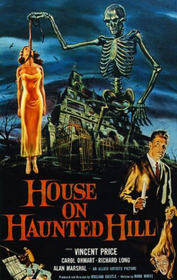
first time I watched The House on Haunted Hill I was impressed. It was
creepy and captivating, Vincent Price was brilliant and the
atmosphere and story-line were completely immersive. I was in
love. However, when I re-watched the film for this review, I made a
startling discovery: my memory is a dirty, filthy liar. On second
pass, Haunted Hill was far less opulent, the casting less
appropriate, and the overall experience somewhat dull and stunted.
While it's certainly not a bad film, this review, sadly, is tinged
with bitter disappointment.
Frederick Loren, an eccentric
millionaire, is throwing a party for his estranged wife, Annabelle.
It is not, however, your normal social gala. Each guest, total
strangers to one another, has been invited by Mr. Loren with the
promise of 10,000 dollars if they can stay, and survive, the night in
a haunted mansion. As expected, when the doors lock for the night,
the natural and supernatural hijinks begin.
On
its surface, The House on Haunted Hill doesn't disappoint, provided
you know what to expect. This movie is fun.
It's not a benchmark of cinematic acheivement, or even something to
tell your friends about next week. But, when you've nothing better to
do and a bowl of popcorn that needs eating, its a fantastic way to
pass the time. The effects are gimmicky. The severed heads look
suspiciously like rubber and the rope that moves of its own accord is
obviously on wires. And the vat of acid? That's there just because
it would be an awesome way to off somebody. And the screams are
downright ear-piercing. There is something to look forward to around
every corner, even if it just a skeleton suspended from the ceiling.
The wackiness of House on Haunted Hill is just downright
awesome.
The gimmicky effects and classic horror tropes are
tempered by a rather well-done set. It's your typical haunted
mansion, with extravagant and exotic décor, lush furniture and
dangerous chandeliers. It gives these cheap special effects a home,
somewhere they belong and don't seem out of place. It seems
natural that, when Nora is locked in a Victorian basement, she would
encounter a ghastly ghoul, since these are the kinds of houses that
ghastly ghouls like to call home. The set adds to the overall
atmosphere of the film, making it seem somehow more plausible, or at
least acceptable. (Of course, none of this explains the Frank Lloyd
Wright building shown in the exterior shots. But I'm choosing
to ignore that; I really don't know how to comment on it.)
All
of this is complemented by some beautiful lighting. With few
exceptions, the rooms and hallways are always shadowed, such that the
viewer can't actually see who or what is moving around. And, of
course, when you can't see what's coming, it's always more
terrifying. Ensconced in shadows, its impossible to tell if that
movement really was just the wind, or if that shadow coming down the
stairs is really human. The film is full of indistinct shapes and
obscured movement, giving it a somewhat creepy feeling despite the
general hokeyness of the surrounding décor. Overall, it lends just
enough credence to the spooky happenings, tempering the
ridiculousness and making the whole film easier to swallow.
However,
despite the overall appearance and fun flow of the film, the very
heart of House on Haunted Hill is its character. People, more than
anything else, are the lifeblood of House on Haunted Hill, so much
that beyond the interpersonal intricacies, there's not much else to
say. Most of the ghostly activity can be explained by backstabbing
and double-crossing, and most of the suspense is driven by human
suspicion and fear rather than spooks and gore. And for that reason,
the most important part of this film is casting. It is with a heavy
heart that I have to say they screwed up.
Vincent
Price is, as ever, cordial and creepy. His dulcet soothing voice
contains undertones of malice that just set your teeth on edge. His
languid, inviting posture are not friendly in the slightest,
reminding the viewer of a hungry cat that isn't to be trusted. And
the smile is chilling, never once reaching his eyes. Price, in
Haunted Hill, is everything we have come to expect of the man's
horror performance: expressive, captivating and terrifying.
Unfortunately, and it pains me to say it, it is exactly what this
film does not need.
Price's performance doesn't leave any
question as to Loren's demeanor or intentions. It's clear from
the beginning that he has called this party together as a means of
getting rid of his wife, that he is a conniving untrustworthy
bastard, and that everyone else in that house is just his pawn to be
played. Which is unfortunate, since the surprise twist in the film is
that Loren, while kind of a jerk, was the very clever victim of his
wife's charade who got the upperhand and gave them what they
deserved. Price's performance is heavy-handed, leaving no room for
doubt or second-guessing - which is exactly what Loren's character
requires. This might have been an attempt to distract the viewer from
the twist ending, but it somehow makes the twist less surprising.
While Price may not have been the central culprit, his performance
makes him seem the mastermind. The real villains, who eventually get
their comeuppance, almost seem like victims in light of Price's
overt sinister-ness, muting the surprise twist and making the climax
a bit disappointing.
Despite
my disappointment with major casting decisions, I feel like credit
should be given where credit is due. In particular, Carolyn Craig,
who plays the easily-upset Nora, and Elisha Cook Jr., the drunken,
half-mad owner of the house, both have "crazy person" down to a
science. Cook is a raving lunatic from the beginning, and never once
wavers. Simpering his dire warnings, which become slightly more
slurred with drink as the film continues, he never lets us forget
that the house is haunted. Cooks eyes almost bug from his head,
particularly when he senses that the ghosts are near, and, as a
result of this performance, the audience is forced to wonder if all
of the phenomenon can be explained by the human intrigues going on
all around us.
Craig's performance is more subtle, though
equally good. She starts off the film all wide-eyed innocence, with a
clinginess to Lance that is almost irritating. However, she's
poised and self-controlled: Nora is a lady. Then she sees a "ghost"
and the breakdown begins. Aside from the scream-queen interludes when
she's faced with something particularly horrifying, Craig portrays
Nora's descent into hysteria with nuanced skill. After each shock,
Nora's character becomes more brittle, her movements jerkier, her
eyes a little shiftier and her voice a little shriller. When she
finally cracks, into full on hysteria, Craig's eyes are wide
and wild, her movements uncoordinated, as she runs blindly down the
hall. We not only believe that this is a woman who has been pushed to
madness, but thanks to Craig's careful build-up, we saw how she got
there.
I
find it very hard to recommend this film, despite there being a lot
of positive things to say about it. The acting is about 50/50, and
the overall feel of the film is fun. And, at just over 80
minutes, House on Haunted Hill is reasonably entertaining.
Unfortunately, Price's performance leaves me with a twinge of
sadness, since he is so brilliant and yet so completely misplaced.
However, my disappointment may not be yours, and at the very least,
House on Haunted Hill is something everyone should watch at least
once, preferable with good friends, good wine, and plenty of popcorn.








Nice review. I first saw
Nice review. I first saw this movie when I was in grade school and loved it (though even back then I was a bit surprised by how fake the witch looked). Watching it again this summer, however, left me pretty disappointed. Normally I love revisiting movies from my youth, especially scary ones that still seem scary now that I'm older (The Haunting 1963 being a good example), but this one just didn't work for me. Still a fun movie to watch if nothing else it on, and it is still better than a lot of the direct to DVD garbage Hollywood has been plaguing us with.
I'm old enough to have first
I'm old enough to have first seen this in a theater--sans Emergo, dammit. I was pretty young and it scared the hell out of me. I re-watch it every few years and I still enjoy it. Castle gives us one 360 degree shot around the house's main room which is silent. As with the new Paranornal Activity, your eye shoots back and forth trying to pinpoint the spot at which something is going to happen. Of course, nothing happens and we are nicely fooled. The moment is silent as well, and that is disorienting since we're so used to sound cues.
Here's the one thing I find most distracting. In one scene, a supposedly dead woman appears outside a second story window. The rope around her neck reaches through the window and into the room, then wraps itself around Nora's feet. It's easy to see how Castle pulled this off, but how were the murderers in the film supposed to have done this? Certainly they could dangle a woman outside the window, but how did they "train" the rope?
One other note: after watching this movie, take a look at the first hour or so of the remake, just for Geoffrey Rush's amusing and, I suspect, loving recreation of Vincent Price. The ending of this version is terrible, but Rush is a lot of fun.
You reference yourself six
You reference yourself six times in the first paragraph. Yep, you're qualified to be a movie reviewer.
IHaving grown up in th 50's,
IHaving grown up in th 50's, and seeing this movie at 10 and not quite understanding the adult theme, but was scared as could be. Still 1 of my favorite flicks-and only the best villain Vincent-BRAVO!
Well, I am a Vincent Price's
Well, I am a Vincent Price's fan. When a I saw this movie for the first time, four years ago, i felt real terror. For my surprise, I decided to make my students watch this film during some of my classes(they are teenagers) and,despite the fact the film is black and white and old, they enjoyed it . They cried a lot and some of my students said this is the most terrifying movie they ever seen.
To appreciate the
To appreciate the melodramatic plot of "House Of Haunted Hill," you must have what artistic critics might term, "A suspension of disbelief." These movies of yesteryear was aimed at juvenile and unsophisticated adults who enjoyed cheap thrills. Of course, there were some unexplained phenomena in the plot. You were told in the dialogue that Annabelle Loring was not dead, but suspended from the ceiling by a hanging harness. Of course, we kids were smart enough not to try this at home because we knew what might happen. However, how was she able to glide toward a window on the second floor unless there was a blalcony underneath the window. How was the rope able to go through the bars and encircle Nora;s ankles. Who knows? I'll bet the girls in the audience wet their pants when that happened. Those of us who saw this movie had come up from a background of horror radio shows, comic books and the like. We knew how to play the game. It didn't take much to scare us, having told ghost stories around the campfire in a dark woods or listening to Lights Out on the radio. We did not need gore and violence to get our thrills. The kids of today are poorer for not having the experience of having to use your imagination and not having everything explained logically to you. After all, it's only a movie, or is it?