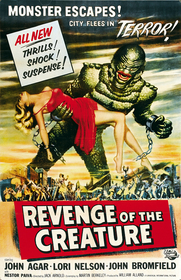
Undoubtedly, this movie will go unseen by many people because it is the sequel to a great piece of horror cinema — a formula that usually results in mediocrity. Creature from the Black Lagoon is a classic, the best swamp monster movie to date, so how can you expect its sequel to be anywhere near as good? Well, realistically, you can’t. Revenge of the Creature works with an interesting premise, established in the original, but instead of studying that premise further, the film merely looks back at it.
The creature, which comes to be called the “Gill Man,” is something between man and fish. It is stuck in the middle of an evolution that should have been completed hundreds of thousands of years ago. The first film focused on the search for and discovery of the creature, followed by repeated attempts to capture it, and, finally, the fight to simply make it out of the swamp alive. In this sequel, the creature is captured for observation and a little conditioning. It is held in an open-air aquarium by a single chain clasped on its ankle. Eventually the creature breaks loose of its captivity, as it always has and always will, and runs amuck in search of its new object of desire, Helen Dobson, the one female scientist who was studying it. If this plot sounds familiar, it should. Not only is it a repetition of the first film, but producer William Alland admitted both were modeled with King Kong in mind1.
Considering the creature’s resilience in the original, it seems odd that they capture it so relatively easily in this sequel. The creature is captured within the first fifteen minutes of the film, and it arrives at the aquarium within the first twenty — no problems in-between. If we want to be generous, we can excuse that on the grounds that what this film is about is what happens after the creature is captured, which is … we learn nothing new, then it escapes. Even if we had learned something new about its biology, the biology is not what makes it an interesting monster. The things it represents — such as transition and the misunderstood — are what we really care about. And, once it escapes, it only does what it did in the original — chases down a beautiful woman. To top it off, not only does this movie repeat the first, it doesn’t do as good a job: the animosity toward the creature yields less of a reaction since the creature is chained for most of the movie, and the creature itself is much less frightening since it is shown so early and so often, not to mention the fact that we’ve already seen it in the first film.The only repeated theme that is handled well at all is the creature’s fascination with the beautiful female, but it still is not up to the original, mainly because the original handled it so well. You just can’t beat the scene from the first in which the creature swims upside-down directly under the object of his lust, simply staring up at her. They even try to copy that scene almost directly in this one, but it is so painfully obvious that it loses all of its appeal.
The special effects are about the only thing truly close to par with the original. Especially for the fifties, the Gill Man is simply a visually great monster. Its fish-blank eyes alone are enough to give you chills at times. Particularly distracting, though, is the stream of bubbles that often rises from the top of the creature’s head. I had assumed that someone must have poked a hole in the mask some time between this film and the first, but if you watch the original closely, you can see the same curious bubbles in some scenes in that movie, too. They were just hidden much better. In this movie they are blatantly obvious.
For all it has against it, however, this film will definitely be enjoyed by devoted fans of 1950's horror/sci-fi. It has everything associated with the concept, even teenagers parked in the woods after dark, a panicking crowd, and, my personal favorite, the monster towering over a helpless little girl. It is almost too stereotypical in that way, but for a modern day audience, it is the sort of stereotype that has become inherently entertaining.
This movie is worth watching once if you have the time, have seen the original, and have a fondness for 1950’s horror/sci-fi, but objectively speaking, it’s just not that good. I would say that I don’t know why it was made, since it does nothing more than rehash the creature’s established characteristics, but it is obvious: Universal wanted to cash in on the Gill Man, one of the greatest monsters of American cinema. The original was a popular movie from the start, so what quicker way to make some money than to create a sequel with a simple plot and no new ideas? The story of the discovery, capture, and study of the monster progresses, but, on a deeper level, we are given no new insights as to what the creature can represent, why it acts as it does, or how we can feel toward it. That is mainly because there is simply nothing more to explore. The first movie did it thoroughly. This one is just sort of here for the hell of it.
1 Weaver, Tom. Commentary. Creature from the Black Lagoon. 1954. Creature from the Black Lagoon: The Legacy Collection. Universal Studios, 2004.
Trivia:
Watch for Clint Eastwood as a lab technician.
Originally released in 3-D.










When I was a kid, this made
When I was a kid, this made it to television before the other two did.
I was seven years old and simply fell in love with it.
Then, about six months later, the original made it's welcome appearance.
I remember thinking the Gill Man suit looked a little more realistic, but
a little stiffer
While I was quite pleased with the movie, I also thought it wasn't as exciting
nor as "epic" as "Revenge" had been.
So, I felt "love" for both, but "Revenge" was more fun.
Then, another 6 months passed and "The Creature Walks Among Us" made it's
appearance.
I felt that this movie had a more mature feel to it and was also a little "scarier"
than the first two.
What I DIDN'T like was all of the time devoted to this poor young woman's sad
marriage to an unstable scientist.
Did they really think people would enjoy experiencing the depressing agony of
such a situation?
But what, thankfully, DID work, was the "Creature's" new, more human-looking
appearance after being severely burned.
But still, the "bad marriage" storyline went on until it suffocated any enjoyment
one could derive from the already sad story of this poor Creature's "symbolic castration".
Leading, finally, to a beatifully haunting conclusion.
Three films, set in three different locations and featuring, three different evolutions of one
beautifully-designed "creature" deservedly became a classic and unforgettable trilogy..