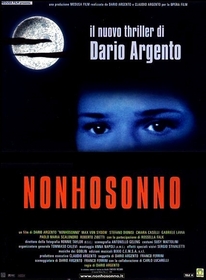
The serial killer formula is ripe
horror fare for film studios looking to grab big money from
easy-to-please gorehounds. In fact, the low expectations from slasher
film fans provide a perfect excuse for studios to focus less on
quality and more on marketing. All a director needs is a flashy look,
a decent soundtrack, a lot of blood, and a script that merely serves
to connect the gore set-pieces. The problem with Sleepless is
that it's directed by a master of suspense films, Dario Argento,
and yet still fits the form.
A young boy, Giacomo, witnesses the
brutal slaying of his mother at the hands of a dwarf. That murder is
one of several that the police in the city of Turin have nicknamed "the Dwarf Killings." With investigators closing in, the killer
disappears. Seventeen years later, a new string of slayings have
occurred that seem eerily similar to the earlier deaths. The victims
are all friends or acquaintances of Giacomo, now a young man working
as a waiter in a Japanese restaurant in Rome. He returns to Turin
and, with the help of his girlfriend and Moretti, a retired detective
who was the lead on the original case, begins his own search for the
killer.
The script for Sleepless offers
little in the way of surprise for fans of the slasher genre, merely
serving as a frame for the murder scenes. As written by Argento,
Franco Ferrini and Carlo Lucarelli, the tired script features an
abundance of cardboard stereotypes (hero with a traumatic past,
guilt-ridden ex-cop, the plucky girlfriend/heroine etc.) and the
requisite serial killer plot devices (methodology linked to
books/science/religion/victims sharing similar traits, murderer's
calling card being left deliberately, the one pattern-breaking murder
that gives the cops a new clue). Here, the deaths are connected to a
child's nursery rhyme, with paper cutouts of barn animals left near
each of the victims' bodies. The one-off death involves a young
lady and offers quite a bit of evidence for our heroic trio to use.
Argento (with an array of neat twists and original characters on his
resume), Ferrini and Lucarelli all seem to be lazily taking a page
from the latest Hollywood straight-to-dvd slasher picture.
Still, with all the problems provided
by the writers, the film does have a fresh, arty look and a pace to
it that carries the film past the story issues. Perhaps writer
Argento should thank director Argento for enlivening things and for
bringing his box of visual tools. Working with cinematographer Ronnie
Taylor, Argento once again brings the camera into the story as an
added character of sorts. Whether he uses the lens to show a facial
reaction or letting the camera linger a bit on birds or inanimate
objects, Argento's visual trickery at once deftly adds to the
somber mood of Sleepless and makes the camera a powerful
weapon in drawing the filmgoer in. The latter is most evident
whenever the killer appears. Argento and Taylor photograph each of
the murders from the point of view of the killer. This works because,
while the audience is forced to look at events through the eyes of a
twisted personality, we get a full view of the looks of sheer terror,
shock, and slight resignation on the faces of each victim. These
scenes are imbued with an immediacy and, frankly, there are few
better, more blunt methods of luring fans in than injecting an
urgency to the proceedings.
Much of the fun of Sleepless comes
from its at times delirious pace. Though coming in at rather lengthy
running time for a thriller, 116 minutes, the film nevertheless is
edited with a tone and style befitting a director who has built a
career making well-crafted thrillers. There are plenty of action and
shocks to keep viewers involved throughout and Argento keenly avoids
lulls by eschewing any long exposition or dialogue-heavy scenes. One
highlight sequence is a cracking, energetic chase on a train between
the psycho and a victim near the film's opening. Mixing the sounds
of the train, the heavy breathing of the victim, and a minimum of
dialogue, the scene has a frenetic, exciting undertone that sets the
bar for the rest of the film.
Further aiding the fast pace of the
film is the pulse-pounding music soundtrack created by frequent
Argento favorite Goblin. Whenever there's a rare threat of a lull,
their highly-charged, often explosive instrumentals ratchet the
energy back up. With their at times intense music style and expert
usage of the synthesizer, Goblin seems to be a perfect partner for
Argento's stark, moody style of filmmaking. This is most evident
during the bloody finale, where Giacomo comes face to face with the
killer. The section of music used here starts out slow and grows,
matching the escalating intensity as events unfold.
If you think about it, Sleepless is
that rare film where it's director is both its biggest asset and
its major weakness, with a potentially good film suffering somewhere
in-between. It's a shame that Argento the director couldn't have
had a better creative relationship with Argento the writer this time
around. Those two have hit the bullseye on so many previous
occasions, one expects it each time they work together.